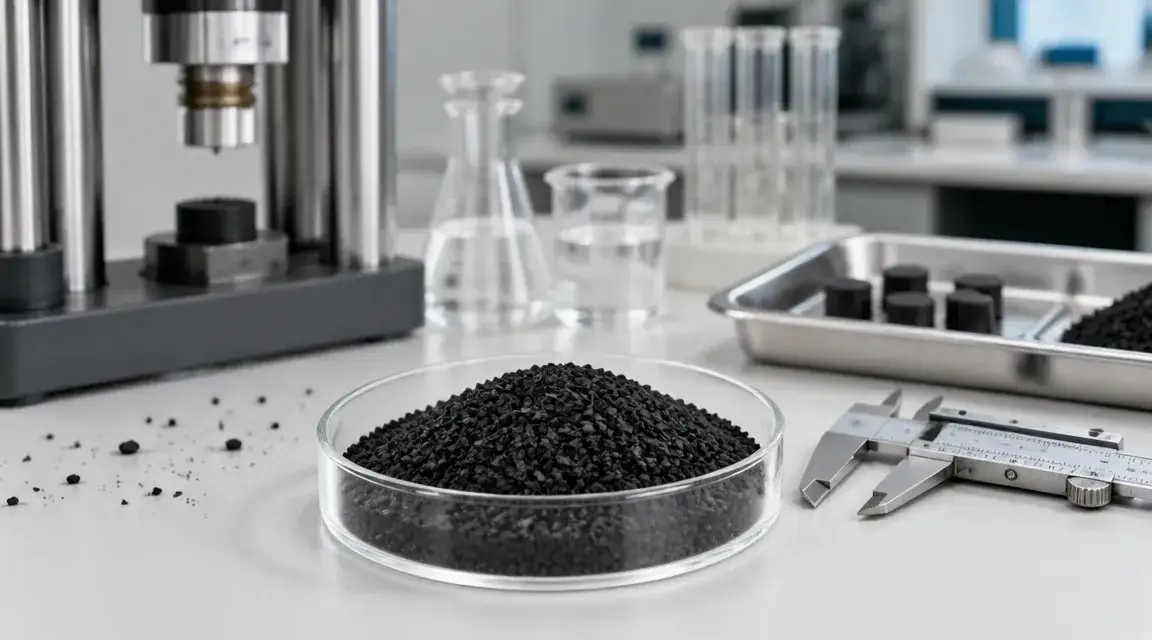
Hardness describes how well activated carbon resists breakdown during handling and operation. It matters when the carbon must stay as stable particles in a bed, vessel, adsorption box, or gold recovery circuit. Weak carbon can create dust, fines, pressure drop problems, product loss, and shorter service life.
Where Hardness Matters Most
Hardness is most important when carbon is exposed to movement, flow, backwashing, vibration, pumping, or regeneration.
| Application | Why Hardness Matters |
|---|---|
| Fixed-bed water treatment | Reduces fines, bed compaction, and flow problems |
| VOC adsorption systems | Helps maintain airflow and reduce dust |
| Solvent recovery | Supports repeated adsorption and desorption cycles |
| Gold recovery | Reduces attrition and loaded carbon loss |
| Bulk handling | Reduces breakage during transport and filling |
[[cta:help]]
Hardness Is Not an Adsorption Number
A hard carbon is not automatically the best adsorbent, and a high adsorption number does not guarantee strong particles. Buyers need both: adsorption fit for the target contaminant and mechanical strength for the equipment.
For example, a VOC system may need CTC value and low pressure drop, while a gold recovery circuit needs hardness, particle size, and attrition resistance.
[[product:goldRecovery]]
Dust Is a Cost Issue
Dust and fines can increase cleaning, pressure drop, product loss, and complaints during handling. In gold recovery, fine carbon can be especially costly if it carries value out of the circuit.
This is why low-cost activated carbon should be evaluated carefully in mechanically demanding applications.
[[product:coalBased]]
How Buyers Should Use Hardness
Use hardness as a screening factor when the carbon will be used in fixed beds, adsorption boxes, or mining circuits. For powdered activated carbon, hardness is usually less important than dosage, mixing, and filtration behavior.
If you are replacing a grade that creates too much dust or breaks down too quickly, send Tanjin Carbon the application, current particle size, handling method, equipment type, and replacement problem. We can compare stronger grade options around the actual operating stress.
Source
- ASTM International, ASTM D3802 Standard Test Method for Ball-Pan Hardness of Activated Carbon
Interested in Our Products?
Leave us a message and we'll get back to you within 24 hours.