- Where Activated Carbon Works in Gold Recovery
- How Activated Carbon Adsorbs Gold
- Why Coconut Shell Carbon Is Often Preferred
- Choosing a Gold Recovery Carbon Grade
- Specifications That Matter in Gold Recovery
- Procurement Risks Mines Should Watch
- Common Buying Questions
- Request a Gold Recovery Carbon Quote
- References
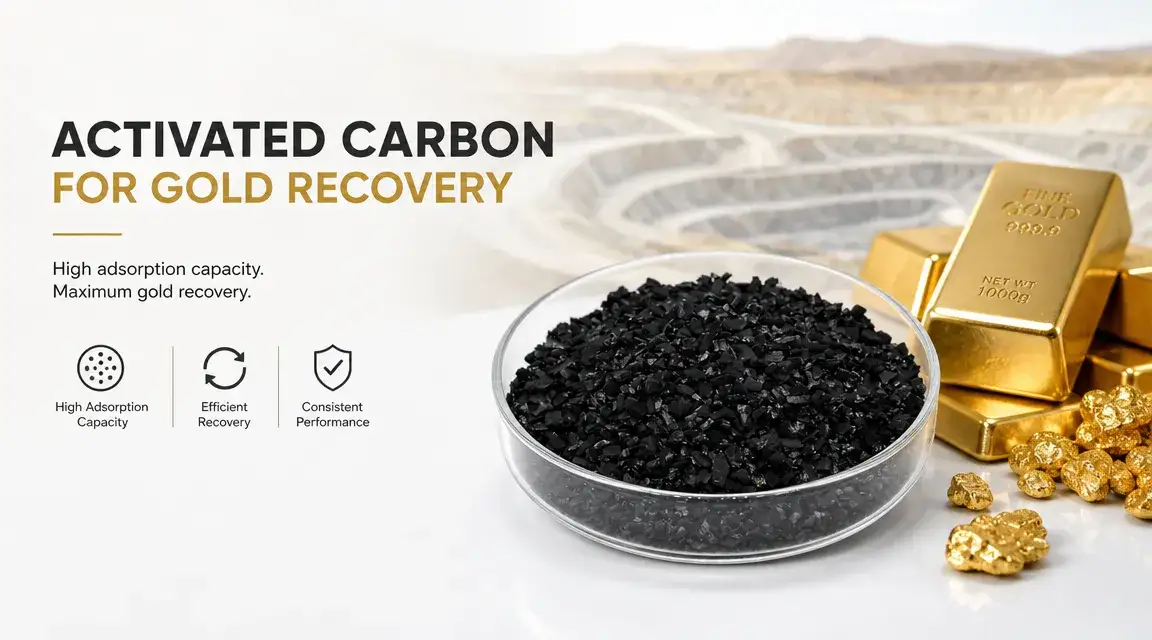
In a gold recovery circuit, activated carbon is not just an adsorbent sitting quietly in a filter. It moves through slurry, screens, pumps, elution, regeneration, and repeated handling. If the carbon breaks down, the plant can lose carbon, gold-loaded fines, and operating time.
That is why coconut shell activated carbon is widely used for CIP, CIL, and CIC gold recovery. The right grade must adsorb gold cyanide complexes while staying hard enough to survive the circuit.
This guide explains where gold recovery carbon is used, how adsorption works, which specifications matter, and what information helps Tanjin Carbon recommend a suitable mining grade.
Where Activated Carbon Works in Gold Recovery
Activated carbon is used after cyanide leaching to recover dissolved gold from solution. The exact carbon duty depends on the circuit design.
| Gold Process | Main Buying Concern |
|---|---|
| CIP (Carbon-in-Pulp) | Carbon moves through pulp after leaching; hardness, attrition, screen retention, and loaded fines matter |
| CIL (Carbon-in-Leach) | Leaching and adsorption happen together; carbon must tolerate slurry contact and repeated movement |
| CIC (Carbon-in-Column) | Pregnant solution flows through carbon columns; particle size, flow behavior, adsorption rate, and pressure drop matter |
| Heap leach adsorption | Carbon handles pregnant solution from heap leaching; adsorption capacity, particle stability, and column behavior matter |
| Existing carbon replacement | Match mesh size, screen opening, carbon movement, elution behavior, and current loss problem |
The risk is different from many water or air applications. A gold circuit does not only ask, “Can this carbon adsorb?” It asks, “Can this carbon adsorb gold and stay in recoverable particles after repeated cycling?”
How Activated Carbon Adsorbs Gold
In cyanide leaching, gold is dissolved into solution mainly as a gold cyanide complex. Activated carbon adsorbs this dissolved gold species onto its internal pore surface.
The process is easier to understand in stages:
- Gold is dissolved into a cyanide solution during leaching.
- Gold cyanide complexes move from solution toward the carbon particle.
- The complexes enter the pore structure and attach to internal carbon surfaces.
- Loaded carbon is separated by screens and sent to stripping or elution.
- Carbon is regenerated or reused, depending on the circuit.
This is why both adsorption and mechanical strength matter. A carbon with good adsorption but poor attrition resistance can still be expensive if fine loaded carbon escapes screens. A hard carbon with weak adsorption is also not enough.
Why Coconut Shell Carbon Is Often Preferred
Coconut shell activated carbon is commonly selected for gold recovery because well-made grades can combine strong micropore structure, high hardness, and low ash. The dense particle structure helps the carbon resist abrasion in CIP and CIL circuits.
But the raw material name is not enough. Not every coconut shell activated carbon is a gold recovery grade. A buyer still needs to check particle size, hardness, attrition resistance, adsorption behavior, ash, moisture, and batch consistency.
Choosing a Gold Recovery Carbon Grade
The starting grade should match the circuit, not just a price list. For gold recovery, a product-selection table is more useful than asking only for a high iodine number.
| Carbon Option | When It Is a Good Starting Point |
|---|---|
| Coconut shell gold recovery activated carbon | CIP, CIL, CIC, and heap leach systems where hardness, attrition resistance, and gold adsorption matter |
| 6x12 mesh gold carbon | Common starting point when screen retention and lower fines risk are important |
| 6x16 mesh gold carbon | Consider when the circuit uses finer carbon and can manage screening and pressure behavior |
| General coconut shell granular carbon | Only consider after confirming it is suitable for gold circuits; raw material alone is not enough |
Gold recovery activated carbon should be treated as a mining-grade material, not a generic GAC. The grade needs high hardness, controlled mesh size, low fines, and consistent adsorption behavior.
[[product:goldRecovery]]
Coconut shell activated carbon is often the raw material basis for gold recovery grades, but the gold application still needs tighter control than ordinary water or polishing carbon.
[[product:coconutShell]]
If you are replacing carbon in an existing circuit, send your circuit type, mesh size, and current carbon loss problem for a gold recovery carbon recommendation. The current failure mode is often the best clue for grade selection.
Specifications That Matter in Gold Recovery
Gold recovery carbon should be evaluated by operating risk, not only purchase price. The most important specifications are the ones that affect gold adsorption, carbon survival, and screen recovery.
| Specification | Buying Note |
|---|---|
| Mesh size | Common mining grades include 6x12 and 6x16; match screens, flow behavior, and circuit design |
| Hardness / attrition | Critical for reducing fines, carbon loss, and gold-loaded particle escape |
| Iodine number | Useful adsorption indicator, but not enough by itself for mining circuits |
| Ash content | Lower ash is generally preferred because impurities can affect circuit behavior and carbon quality |
| Moisture | Affects shipment weight, handling, and storage |
| Bulk density | Helps estimate carbon volume, loading, and handling behavior |
| Batch consistency | Important for mines buying repeat shipments and trying to stabilize circuit performance |
Tanjin Carbon’s gold recovery product information lists coconut shell grades with iodine number above 1000 mg/g, hardness above 98%, moisture at or below 5%, ash at or below 5%, and 6x12 or 6x16 mesh options. Exact selection should still follow the circuit and trial result.
For a broader explanation of strength and fines, read Why Hardness Matters in Activated Carbon.
Procurement Risks Mines Should Watch
Do not buy by iodine number alone. A high iodine number does not protect the plant from fines, attrition, screen loss, or poor batch consistency.
Check the screen and mesh match. If the carbon is too small for the screen system, loaded carbon fines can become a serious loss point. If it is too coarse, adsorption rate and flow behavior may be affected.
Ask about attrition, not only hardness. Hardness is useful, but the circuit cares about how much carbon breaks into fines during real movement, pumping, screening, elution, and regeneration.
Watch total operating cost. A cheaper carbon can cost more if it increases makeup carbon, loses gold-loaded fines, or shortens the replacement cycle.
Common Buying Questions
Is coconut shell carbon always suitable for gold recovery?
No. Coconut shell is often preferred, but the grade still needs mining-specific hardness, low attrition, suitable mesh size, and stable adsorption behavior. A general coconut shell granular carbon may not be suitable for CIP or CIL.
Is 6x12 or 6x16 mesh better?
It depends on the circuit screens, flow behavior, adsorption rate, and carbon movement. 6x12 is a common starting point where screen retention and lower fines risk matter. 6x16 may be used where the circuit is designed for finer carbon.
What information should I send for a quote?
Send the process type, current mesh size, screen opening if known, carbon loss or attrition problem, monthly usage, packaging preference, destination, and whether the order is for trial or repeat supply.
Request a Gold Recovery Carbon Quote
Gold recovery carbon should be selected around the circuit, not just the raw material name. The best starting grade is the one that balances adsorption, hardness, mesh size, attrition resistance, and screen compatibility.
For a practical recommendation and quotation basis, request a gold recovery carbon quote with your circuit requirements.
References
Interested in Our Products?
Leave us a message and we'll get back to you within 24 hours.