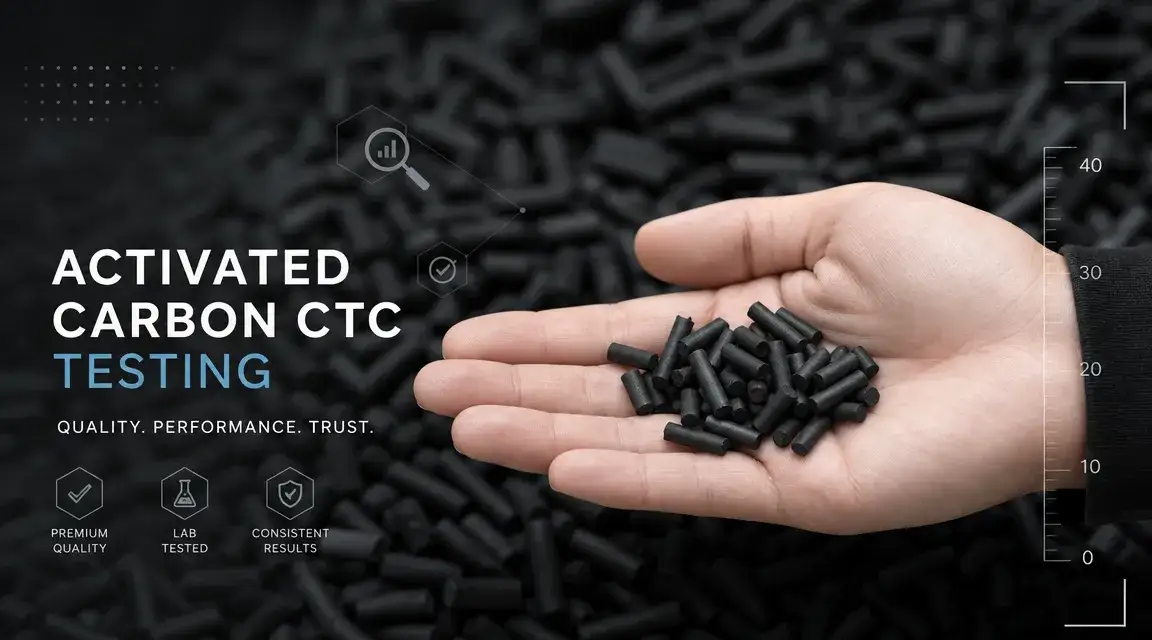
CTC value is a gas-phase activated carbon specification used as a reference for adsorption capacity under a standard test. It is especially relevant for VOC removal and vapor adsorption, but it does not predict service life by itself. Buyers still need to consider VOC type, concentration, humidity, airflow, particle form, and pressure drop.
Where CTC Value Fits
CTC value is useful when comparing activated carbon grades for gas adsorption. It is commonly discussed for pellet activated carbon, granular carbon used in gas beds, and selected specialty grades.
It is less useful for water treatment, food decolorization, or applications where gas-phase adsorption is not the main function.
[[cta:help]]
CTC Does Not Replace Gas Data
Two carbons with different CTC values may perform differently in a real VOC system, but the gas stream still controls the outcome. Humidity, temperature, airflow, inlet concentration, and bed depth can change service life dramatically.
For buyers, the most common mistake is asking for “high CTC” without sharing the operating conditions. That can lead to a more expensive grade without solving the actual system problem.
[[product:pellet]]
What to Compare With CTC
| Factor | Why It Matters |
|---|---|
| VOC type and concentration | Determines adsorption difficulty and loading rate |
| Humidity | Can reduce effective adsorption capacity |
| Airflow and bed depth | Controls contact time and pressure drop |
| Pellet or particle size | Affects airflow stability |
| Moisture and hardness | Affects handling and bed performance |
| Replacement plan | Determines real operating cost |
For application selection, read Activated Carbon for VOC Removal: Buyer’s Selection Guide.
When Specialty Carbon May Be Needed
Some gas streams contain contaminants that standard activated carbon may not handle well. In those cases, impregnated activated carbon may be discussed. The choice should be based on the target gas, not on a generic upgrade assumption.
[[product:impregnated]]
What to Send for a VOC Recommendation
Send the VOC type or mixture, concentration, airflow, temperature, humidity, equipment dimensions, required outlet target, quantity, packaging, and destination. Tanjin Carbon can then recommend a starting grade around the system conditions rather than quoting CTC value alone.
Sources
Interested in Our Products?
Leave us a message and we'll get back to you within 24 hours.