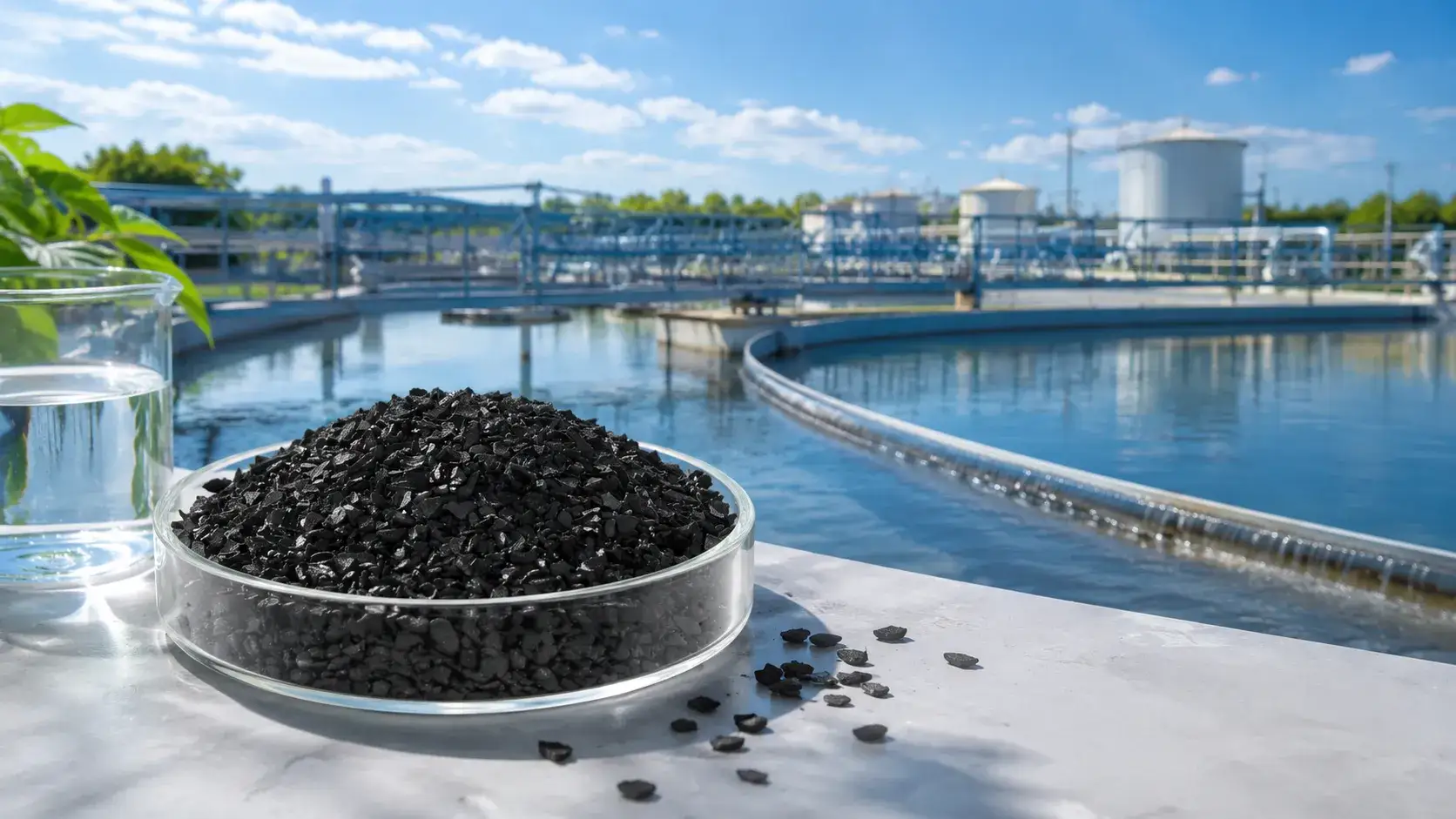
Activated carbon is used in water treatment when dissolved contaminants need adsorption rather than simple filtration. Typical targets include taste, odor, color, chlorine-related compounds, and some dissolved organic pollutants.
For buyers, the main question is not whether activated carbon can be used. It is which form, mesh size, iodine number, hardness, ash level, and replacement plan fit the water source and equipment.
This guide explains the adsorption principle, common water treatment uses, typical activated carbon parameters, and what to send Tanjin Carbon for a practical quote.
Water Treatment Problems That Lead to Activated Carbon
Activated carbon is often considered when a water system still has a quality problem after basic treatment.
Common cases include:
- Taste and odor control in drinking water, bottled water preparation, or facility water.
- Color reduction in process water, wastewater, or liquid streams.
- Organic polishing after biological treatment, filtration, membrane systems, or chemical treatment.
- Chlorine-related polishing before sensitive downstream use.
- COD support when part of the remaining COD is caused by adsorbable organics.
The application matters because each case puts different pressure on the carbon. Drinking water polishing usually needs clean granular carbon with stable pH and low dust. Wastewater polishing may need stronger fouling tolerance and real-water testing. Emergency odor or color response may use powdered carbon because it contacts the water quickly.
How Activated Carbon Adsorbs Contaminants in Water
Activated carbon works by adsorption, not absorption. Contaminant molecules move from the water into the carbon’s pore structure and attach to internal surfaces. The better the match between the contaminant, pore size, and contact conditions, the better the adsorption result.
Small dissolved organics may be screened with iodine number because iodine number reflects micropore adsorption capacity. Larger color bodies may need different pore structure and are often judged with parameters such as methylene blue value or actual decolorization testing.
Activated carbon does not solve every water problem. High suspended solids can block pores. Oil can foul the bed. Strongly variable wastewater can shorten service life. Non-adsorbable dissolved salts, heavy metals, or inorganic ions may need other treatment methods.
So the buying question is not only “What is the iodine value?” It is:
Will this carbon’s pore structure, particle size, and mechanical strength match my water and equipment?
Choosing the Right Activated Carbon for Water Treatment
Use product form first, then parameters. A good water treatment quote should say more than “activated carbon.” It should name the form, size, and key specifications.
| Water Treatment Use | Practical Starting Point |
|---|---|
| Fixed-bed water filter | Granular activated carbon, often 8x30 or 12x40 mesh; check iodine number, hardness, pressure drop, bed depth, and replacement interval |
| Drinking water polishing | Coconut shell or coal-based GAC with low dust, suitable pH, controlled ash, and stable taste/odor performance |
| Industrial wastewater polishing | Coal-based GAC or PAC depending on process; test with real water because competing organics and fouling can shorten service life |
| Batch dosing or emergency treatment | Powdered activated carbon; confirm dosage, contact time, and downstream separation method |
| Color reduction | Often powdered or wood-based carbon; compare methylene blue value, dosage, filtration speed, and pH behavior |
Granular activated carbon is usually the first choice for fixed-bed filtration. For many water filters, common sizes include 8x30 and 12x40 mesh. A typical iodine number discussion may fall around 900-1100 mg/g, but the best value depends on the target contaminant.
[[product:granular]]
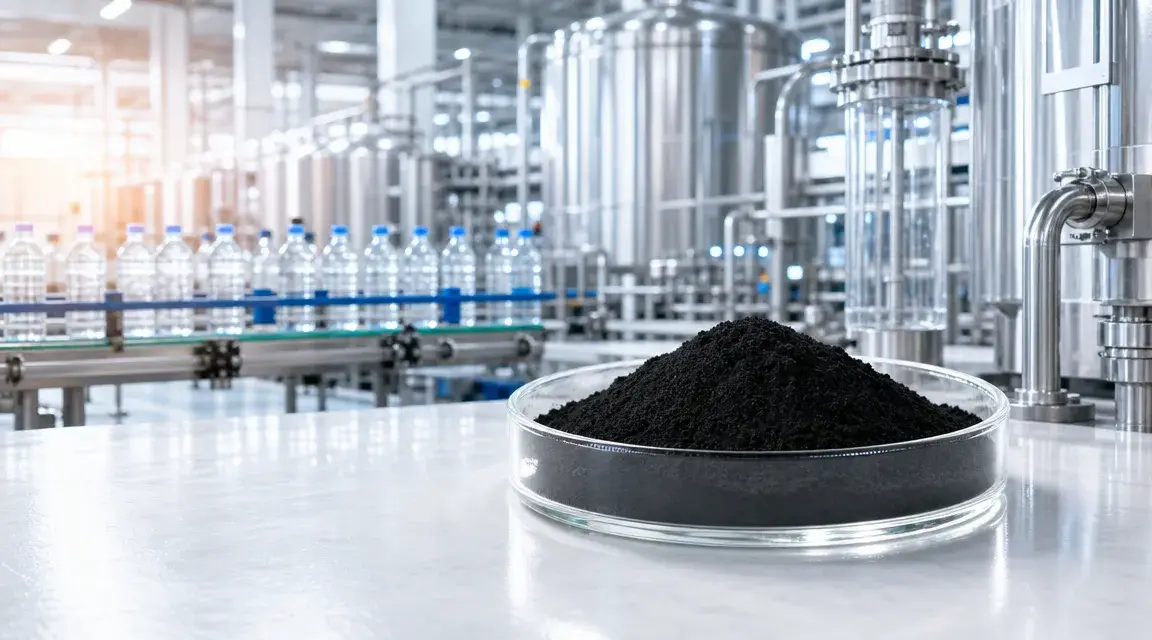
Powdered activated carbon is better when the process needs fast contact, dosing flexibility, or short-term treatment. It is not a drop-in replacement for GAC because the powder must be removed after adsorption.
[[product:powdered]]
For drinking water or premium filtration, coconut shell GAC may be considered where hardness, low ash, and low dust matter. For industrial water and wastewater polishing, coal-based GAC is often a practical starting point because of its balanced pore structure and cost-performance profile.
Procurement Notes for Water Treatment Buyers
Flow rate and contact time decide whether the carbon has enough time to adsorb the target contaminants. If water passes too quickly through the bed, a high-spec carbon can still underperform.
Particle size controls pressure drop and contact. Finer GAC can increase pressure drop. Coarser GAC may lower contact efficiency in some systems. The right size depends on vessel design and flow.
Ash and pH matter in sensitive water. Drinking water, beverage water, and process water may need closer control than general wastewater polishing.
Hardness affects fines and service life. Fixed-bed filters, backwashing, and transport can create fines if the carbon is weak. Fines can cause turbidity, pressure drop, or media loss.
Real-water testing matters for wastewater. Wastewater contains competing organics, solids, oil, and pH variation. A specification sheet cannot fully predict service life.
For broader specification review, read 10 Activated Carbon Specifications Every Industrial Buyer Should Check. For mesh selection, see Activated Carbon Particle Size and Mesh Selection Guide.
FAQ
What contaminants can activated carbon remove from water?
Activated carbon is strongest for adsorbable organic compounds, taste and odor compounds, color-related organics, chlorine-related polishing, and some VOCs in water. It is not a universal solution for dissolved salts, all metals, or high suspended solids.
Is 8x30 or 12x40 mesh better for water treatment?
Both are common for water filters. 8x30 is often used where lower pressure drop is important. 12x40 can provide more surface contact but may increase pressure drop depending on the system. The vessel and flow rate decide the better choice.
Is a higher iodine number always better for water treatment?
No. Iodine number helps compare micropore adsorption, but water treatment also depends on particle size, hardness, ash, pH, fouling risk, and contact time.
Request a Water Treatment Carbon Quote
To recommend the right grade, Tanjin Carbon needs the water type, target contaminant or problem, flow rate, equipment type, preferred mesh size if known, current carbon issue, quantity, packaging, and destination.
Tanjin Carbon can help match GAC or PAC to drinking water polishing, industrial wastewater, process water, odor control, or color reduction. Request a water treatment carbon quote with your water data, target result, quantity, packaging, and destination.
References
Interested in Our Products?
Leave us a message and we'll get back to you within 24 hours.