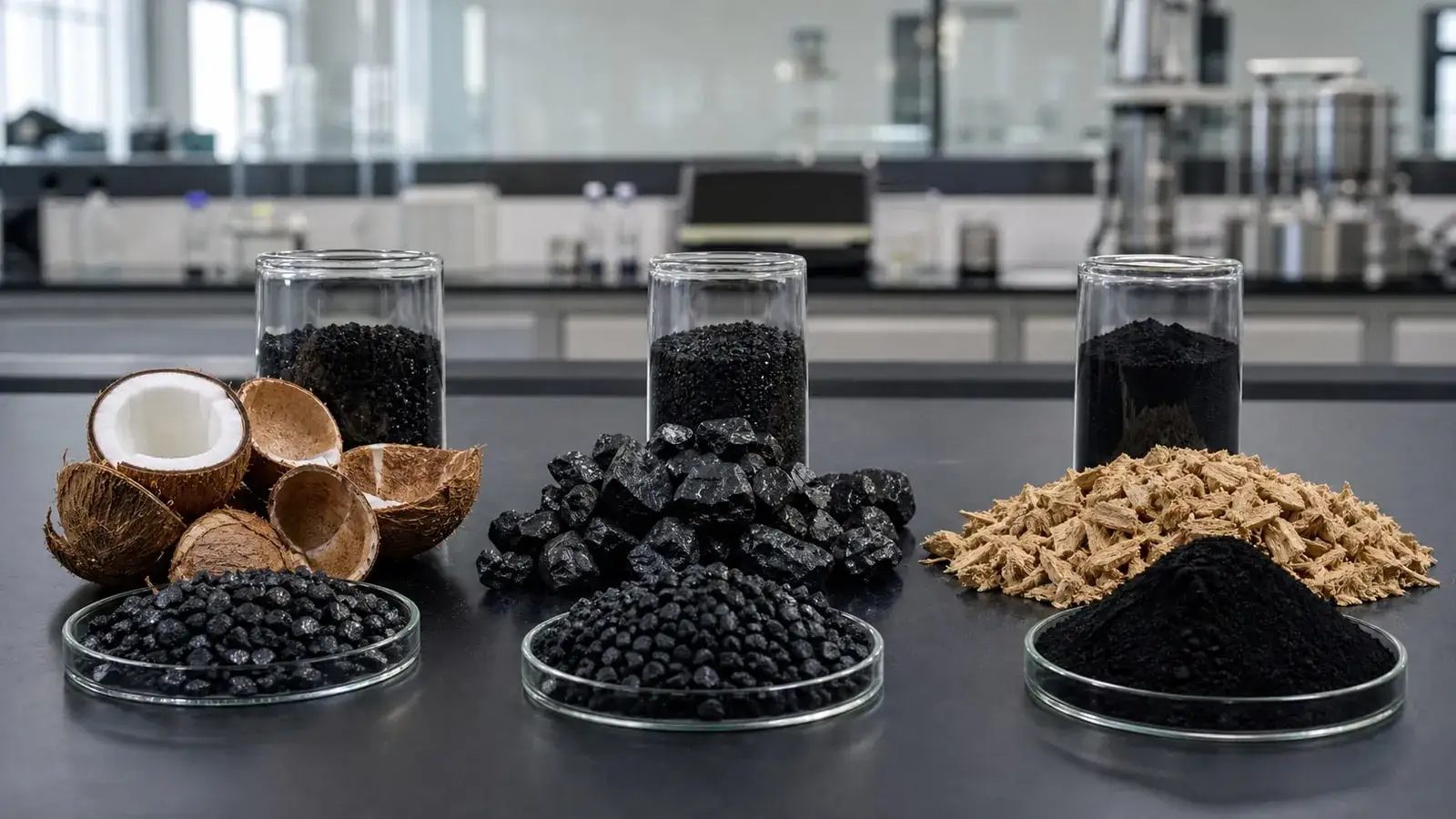
Coconut shell, coal-based, and wood-based activated carbon are not simple quality levels. They are different raw material routes with different strengths. The right choice depends on the contaminant, process, equipment, purity needs, and cost target. Buyers should avoid choosing a raw material because it sounds premium; choose the one that fits the job.
Fast Comparison
| Raw Material | Often Strong In | Watch Carefully |
|---|---|---|
| Coconut shell | Hardness, micropore structure, gold recovery, water polishing | May not be the most economical broad-use option |
| Coal-based | Industrial water, gas treatment, general adsorption | Ash, particle size, and application fit vary by grade |
| Wood-based | Decolorization, larger molecules, liquid processing | Filtration, ash, and dosage must be tested |
Coconut Shell Activated Carbon
Coconut shell activated carbon is often considered when hardness and micropore structure matter. It is common in water polishing and gold recovery, and it may be used in selected air purification applications.
It is not automatically the best carbon for every project. If the target molecules are larger or the buyer needs low-cost broad industrial treatment, another raw material may be more practical.
[[product:coconutShell]]
Coal-Based Activated Carbon
Coal-based activated carbon is widely used in industrial water treatment, wastewater polishing, gas purification, and general adsorption projects. It can be a strong option when the buyer needs balanced performance and practical cost.
The key is choosing the right grade, not simply asking for coal-based carbon. Particle size, ash, hardness, moisture, and application fit still matter.
[[product:coalBased]]
Wood-Based Activated Carbon
Wood-based activated carbon is often considered for decolorization and liquid-phase applications where larger organic molecules matter. It is commonly discussed for sugar, food ingredients, chemical liquids, and other process streams.
For these applications, the buyer should test dosage, color removal, filtration speed, pH behavior, and final product impact. A specification sheet alone rarely tells the full story.
[[product:woodBased]]
How to Choose Without Overcomplicating It
Start with the application:
- Gold recovery or high mechanical stress: consider coconut shell grades.
- Industrial water or general adsorption: compare coal-based and coconut shell options.
- Decolorization or larger liquid-phase molecules: consider wood-based or powdered grades.
- Sensitive pH or ash requirements: discuss washed grades.
- Gas-phase VOC treatment: focus on CTC value, pellet or granular form, and pressure drop.
For product form decisions, read Granular vs Powdered vs Pellet Activated Carbon: Which One Should You Buy?.
Choose by Application, Then by Cost
Raw material should narrow the options, not finish the purchase decision. Tell Tanjin Carbon the application, target, equipment, quantity, packaging, and destination. We can compare coconut shell, coal-based, and wood-based options around the actual use case instead of forcing one raw material into every project.
Interested in Our Products?
Leave us a message and we'll get back to you within 24 hours.