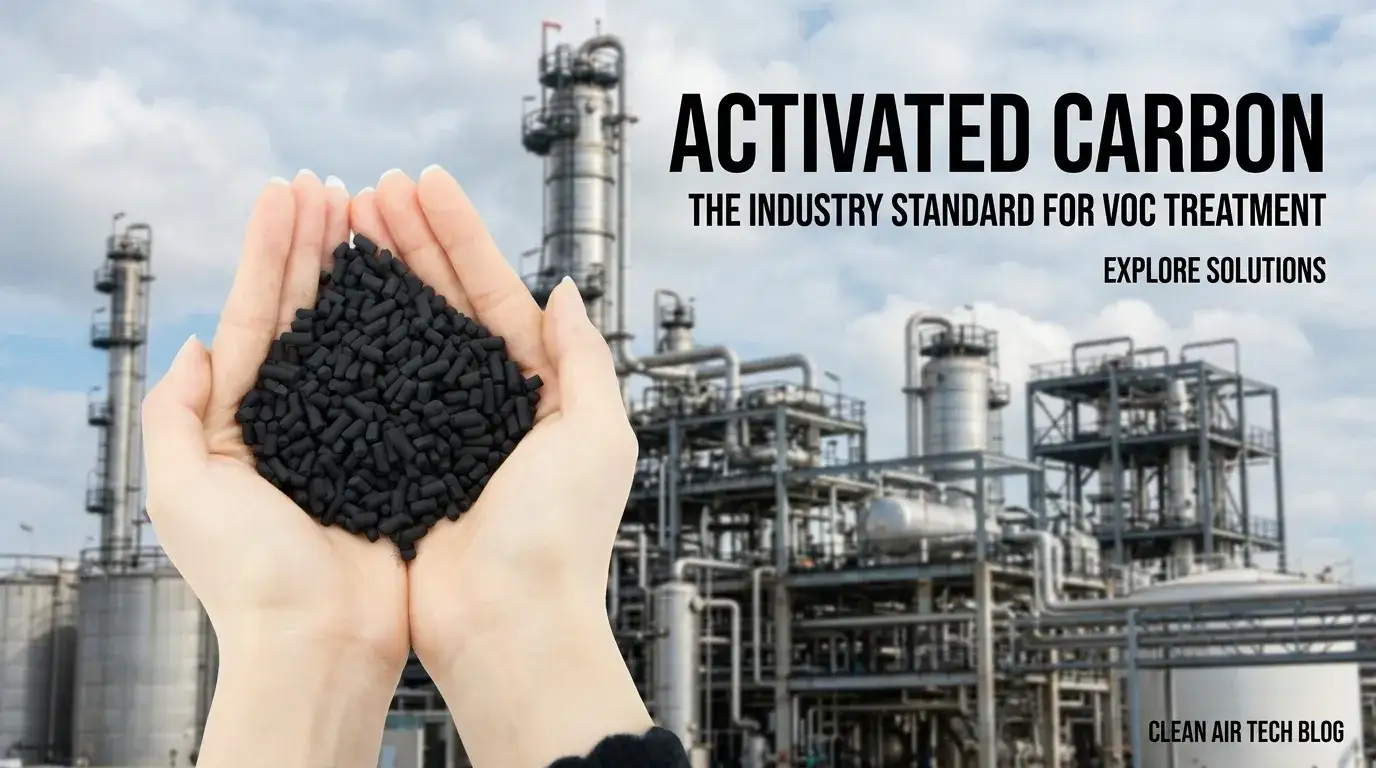
Activated carbon is used for VOC removal because many organic vapors can attach to the internal pore surface of activated carbon. This makes it useful for coating lines, printing exhaust, solvent vapor, chemical exhaust, fuel vapor, and odor control systems.
The mistake many buyers make is treating VOC carbon as a single product. The right grade depends on VOC type, concentration, airflow, humidity, temperature, bed design, pressure drop, and expected replacement cycle.
This guide explains how activated carbon adsorbs VOCs, which carbon types are commonly used, which parameters matter, and what information helps Tanjin Carbon prepare a practical quote.
VOC Problems That Lead to Activated Carbon
VOC treatment usually starts when an exhaust stream has solvent odor, organic vapor, or emission-control pressure.
Common examples include:
- Coating and spraying exhaust with solvent odor and changing concentration.
- Printing and packaging lines with mixed organic vapors.
- Chemical exhaust where gas composition and temperature may vary.
- Solvent storage or transfer vapor where capture or recovery may matter.
- Low-to-medium concentration ventilation air where a fixed-bed adsorber is practical.
These streams behave differently. A low-concentration workshop exhaust may mainly need stable airflow and reasonable service life. A solvent-rich stream may need attention to bed loading, heat release, safety, and changeout. A humid stream may lose capacity faster than expected.
How Activated Carbon Adsorbs VOCs
Activated carbon removes VOCs by physical adsorption. VOC molecules move with the gas stream into the pore network and attach to internal carbon surfaces through weak surface forces. The carbon does not destroy VOCs; it holds them until the bed is saturated, replaced, regenerated, or otherwise treated.
This is why pore structure matters. Micropores provide strong adsorption for many small organic vapors. Mesopores and transport pores help larger molecules reach adsorption sites. Pellet form helps gas move through the bed with lower pressure drop.
Activated carbon works best when the VOC molecules are adsorbable and the gas stream gives them enough contact time. Performance becomes harder when:
- humidity is high and water vapor competes for adsorption space;
- airflow is too high for the bed depth;
- temperature is high and reduces adsorption strength;
- VOC concentration changes sharply;
- the carbon is too fine or dusty and creates pressure drop.
So CTC value is useful, but it is not the whole answer. A gas-phase carbon with good CTC can still fail if the adsorber is undersized or the gas is too humid.
Choosing the Right Activated Carbon for VOC Removal
VOC carbon selection should include product form and gas-phase parameters. A useful quote should mention diameter or particle size, CTC value, iodine number, hardness, moisture, and packaging.
| VOC Situation | Practical Starting Point |
|---|---|
| Fixed-bed adsorption box | Pellet activated carbon, often 1.5 mm / 3 mm / 4 mm; check CTC, hardness, dust, pressure drop, and bed depth |
| General solvent vapor | Pellet or suitable granular carbon; compare CTC value, iodine number, moisture, particle form, and low-dust behavior |
| Humid exhaust | Gas-phase carbon with conservative sizing; humidity can shorten service life and may require pretreatment |
| Specific acid gas or special contaminant | Impregnated activated carbon only when the target compound requires chemical enhancement |
| Existing carbon box replacement | Match the current bed volume, airflow, pressure drop, particle form, and changeout cycle |
Pellet activated carbon is often the first choice for VOC adsorption because the uniform pellets support lower pressure drop and steadier airflow. Common diameters include 1.5 mm, 3 mm, and 4 mm. Depending on raw material and grade, CTC may be discussed around 50-70% or higher.
[[product:pellet]]
Impregnated activated carbon is not a general upgrade for all VOCs. It should be considered when a specific gas requires chemical enhancement. The target compound must be known before choosing this option.
[[product:impregnated]]
Granular activated carbon can also be used in some gas systems, but particle size and dust control must fit the adsorber. If the carbon is too fine, pressure drop can increase and airflow can fall.
Procurement Notes for VOC Buyers
Do not buy by CTC alone. CTC is a gas-phase reference, but service life depends on VOC type, concentration, humidity, airflow, bed depth, and temperature.
Humidity can shorten service life. Water vapor can occupy adsorption sites and reduce effective capacity. If the exhaust is warm and humid, pretreatment or a shorter changeout cycle may be needed.
Pressure drop affects operating cost. A low-cost carbon that increases fan load or reduces airflow may be expensive in operation.
Replacement data improves the quote. If you already use an adsorption box, send the carbon volume, replacement interval, current odor or breakthrough problem, and packing method.
For a parameter-focused explanation, read What Is CTC Value and Why It Matters for VOC Treatment.
FAQ
What VOCs can activated carbon adsorb well?
Activated carbon is generally suitable for many organic vapors such as solvent odors and hydrocarbons, but performance depends on molecular properties, concentration, humidity, temperature, and contact time. The exact VOC mixture should be shared before quoting.
Why does VOC carbon fail early?
Common reasons include high humidity, high airflow, shallow bed depth, high inlet concentration, temperature changes, poor sealing, or using carbon with the wrong particle form.
When is impregnated carbon needed?
Impregnated carbon is considered when the target gas needs chemical enhancement. It should not be selected just because it sounds more advanced.
Request a VOC Carbon Quote
To recommend the right grade, Tanjin Carbon needs the VOC type or mixture, inlet concentration, airflow, temperature, humidity, adsorber size, carbon volume, replacement interval, quantity, packaging, and destination.
Tanjin Carbon can help match pellet, granular, or impregnated activated carbon to VOC adsorption boxes, workshop exhaust, solvent vapor, and industrial air treatment systems. Request a VOC carbon quote with the gas conditions, carbon volume, quantity, packaging, and destination.
References
Interested in Our Products?
Leave us a message and we'll get back to you within 24 hours.